Showing posts with label book suggestions. Show all posts

January 29, 2012

My New Favorite Site!

Am I the last person on the planet to learn about YourNextRead.com? I'm not? Good! After I finish a book, I mull around before I jump into my next book. I pick 2 or 3 books and read the first page or so. If I can't put it down, I keep reading. If I can put it down, I pick another book. I need a way to speed up the process! Normally, I would tell you to ask your librarian or your friend for a book suggestion. But, they aren't always around. So, try YourNextRead.com.
You don't have to sign up for an account, but you can. If you do, you can connect to your GoodReads account and all of your books magically appear!
Let me show you how it works.

Go to YourNextRead.com

Type in the title of the last book you read, or a book you really enjoyed. For this demonstration, I used Dead End in Norvelt.
Click on the correct book and you will be given books that you should consider. How are these books connected? Take a look:
I would say that all of these books are (mostly) historical fiction. Interestingly enough, many of them were on lots of Newbery 2012 watchlists! Hmmm.... If you have read one of the books they suggest, you can give it a thumbs up or thumbs down, depending id you agree or disagree. You can also click on one of the suggested books to see what they might lead to.
I would totally suggest that you read any or all of the books suggested above!

Head over there and try it out! Let me know what you think!

September 8, 2011

September is a Month for Gr8 Books!

I love Goodreads.com and I hope you have visited my page for great book suggestions! If you are on Goodreads, please feel free to send me a message, a book suggestion or add me as a friend. (I tell the kids that Goodreads is like Facebook for smart people!) I got this email from Goodreads this morning... I hope you all know how many fantastic books come out this month! (I've read 2 of these already! Breadcrumbs and Bigger Than a Breadbox) and I just got my copy of 13 Gifts at the book fair for 7 bucks!

July 23, 2011

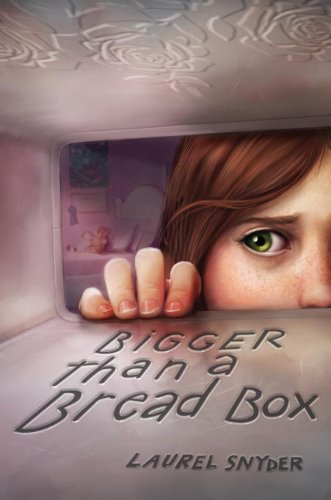
Book Talk: Bigger Than a Bread Box

Everybody's parents fight, right? It's normal. They disagree, say things they don't mean, forget birthdays and anniversaries- but they forgive each other... right? Well, not always. Sometimes parents don't make up. Sometimes a mom or a dad can only take so much before they just need a break. A break- from being married, a break from the person they married. Does this mean they don't love each other? I guess that's what the break will tell them. But what about the kids? When a mom and dad decide to take a break- what happens to them? Do they get a choice in the matter? Probably not... parents usually make those kinds of decisions without consulting the kids. 
But think about it. How would you feel if one morning you woke up and your mom had packed the car and told you that you were going to Atlanta- right this minute. No chance to say goodbye to your friends, or pack your favorite things or turn in your homework. You had to get in the car and leave everything... including your dad. And what if your dad hugged you goodbye and your mom drove away? What if you looked back to see your dad chasing the car and yelling at your mom to come back? How would you feel?
Bigger Than a Bread Box, by Laurel Snyder will show you how you might feel. In this book, Rebecca is the girl who wakes up to find that her mom is leaving her dad in Baltimore and driving to Atlanta to stay with her mother (Gran). Rebecca knew that her parents had been having trouble- but enough trouble to leave her dad behind? And what is worse? Rebecca had no idea. Rebecca had no choice.
After a silent drive from Baltimore to Atlanta, Rebecca, her brother Lew and her mom arrive at Gran's house. When Gran tells her about the new middle school she will be starting on Friday, Rebecca realizes that they aren't there for a few days. She hides in the attic so she doesn't have to talk to her mother. While in hiding, she looks through some of Gran's things and finds a collection of bread boxes. (Bread boxes were used back in the day to keep bread fresh- before it was made with all the preservatives we use today... it would go stale so fast. It also kept out the bugs and the mice)  
Rebecca is drawn to a beautiful red bread box that seems to stand out from all of the others. As she sits in the attic, bored and covered with dust, she wishes, out loud, that she had a book to read. Instantly, she hears a thud come from the red bread box. She opens it up and finds an old ratty copy of a Nancy Drew book. Rebecca takes the book and the bread box back to her room. She wishes that she had 20 bucks- again, the box makes a sound, Rebecca opens it and there is a 20 dollar bill. Rebecca realizes that she can wish for anything that will fit into the bread box and it will appear... it's magic. 
Rebecca decides to use this box to her advantage- she wishes for things that will help her adjust to her new situation. (new jeans for her, lip gloss for the new girls at school, gravy fries to ease her homesickness). Eventually, her wishes start to backfire on her. Everything she wishes for ends up causing her trouble. But when she wishes for something to get her parents back together, the box sits empty. 
What good are wishes when you can't get what you really want? What does Rebecca really want? She wants to go home to Baltimore. She wants her parents to fall in love again. She wants her mom to notice her. She wants the kids at school to think she's cool. She wants to fit it. She wants to make her own decisions. She wants people to listen to her. But can a bread box, even a magical one grant these wishes? May be what she really wants is bigger than a bread box. May be you can't wish for love and have it magically appear... may be love is something that has to appear on its own.
   
In Bigger Than a Breadbox, Rebecca has a memory of her parents when they were their happiest- they would listen to this song and dance around the living room.
I think this is what Rebecca really wanted to find in that box.
This book will be very popular with kids in grades 4-8. From my experience, it will be the girls who devour this book. Most (or some) boys just can't read a book with all of these emotions and feelings and self discovery. If the bread box turned into a robot that destroyed the city of Atlanta with its laser eyeballs, they would love it.  If they give it a chance, they will love this story too. Even though there is a magic breadbox in this book, it still reads like realistic fiction. The times when Rebecca is at her worst- when she is completely devastated by her parent's separation, your heart breaks. You feel every single raw emotion that this little girl feels and you are helpless- you have to watch her go through this storm alone. As a parent, my heart aches to think about how kids take in all of the things that adults do to them, thinking it is for them. They may be kids, but they are little humans who have feelings, desires and opinions. We, adults, are quick to dismiss them because they are shorter than us. I am guilty of this as well. but will be making a concerted effort to change. 
Don't be too quick to play biblio-therapist with this book. It would be easy to say "Oh, Kelly's parents got divorced, she needs to read this book." or "Leah's parent's aren't divorced, she wouldn't relate." But this book has greater appeal than "just the divorced kids". All kids (girls AND boys) want to be loved, all kids want their parents to love each other... all kids have a list of things that they would wish for if they had an unlimited supply of wishes... so let them wish, let them be loved, let them be heard and let them read. 

This is how I picture Rebecca's home in Baltimore


This is how I picture Gran's house in Atlanta

July 20, 2011

Book Talk: Breadcrumbs

I haven't read any reviews of Breadcrumbs by Anne Ursu, and I won't until I hit the publish button at the bottom of this post. I knew this was a much talked about book, lots of Newbery buzz, and I didn't want to be influenced in my reading or my reviewing. 

I am sure you know the story of The Snow Queen, by Hans Christian Anderson- right? Well, Breadcrumbs is a retelling of this fairy tale aimed at the tween crowd.  Jack and Hazel are best friends and accept each other as they are. Hazel has trouble fitting in and Jack is her only friend. Hazel understands why Jack's mom has distant and sad eyes (she has depression). And Jack understands how Hazel feels about her parent's divorce. He doesn't even ask her what it's like to be adopted. They are soul mates in a sense. 
Jack has chosen Hazel over the mean boys at school and the mean boys aren't happy about that. They go out of their way to torment and tease Hazel. One day at recess, a sliver something happens to Jack that turns his heart to ice. He is mean and nasty to Hazel, and then he just disappears.

Hazel can't stand the idea of going on without Jack, so she makes it her quest to find him and save him. She finds out that Jack was taken by a tall, white woman riding a sled pulled by wolves...enter The White Witch (or snow queen as I think of her). Hazel sets off after Jack and endures many setbacks and bad guys along the way. She also encounters many people/creatures who could have helped her but are too consumed with their own troubles to offer her help.  Hazel attempts to help each of them and is very tempted to stay where she is- until she is pulled toward Jack by the power of love. As Hazel continues on her quest, she grows and matures but remains innocent through it all. And in the end, it is Hazel's love for Jack that might just save him from The Snow Queen.

As I read this book, I just let it wash over me. The words are so beautiful, almost like a lullaby. I wanted to enjoy the story and not pick it apart and analyze the meaning... so I waited until now to do that. Now, don't take my opinion as the right one, or the only one;  I think this book allows the reader to form their own opinions and ideas. I am not a psychology major, so go gentle on me in the comments!

I felt so very heavy as I read this book- I started to become as down as the characters- so it took me longer than usual to finish. I think the Snow Queen (White Witch) is depression... mental illness, perhaps.  Jack's mom had depression and it changed his entire life. He was such a young man to deal with something as serious and devastating as having a mother with depression. Jack may have been looking for a chance to hide from it all and forget about his mom- and The White Witch gave him just that: She froze his heart so he couldn't feel anything. I don't think  she did this to be mean, she does it because she cares about him and doesn't want him to feel any more pain.  (To me, The Snow Queen wasn't a bad guy- just a creature that lived in the woods... no bad intentions).
I thought Hazel was very sad- if not depressed. She struggled with her parents recent divorce, money problems, being adopted,  feeling like she didn't belong, a mean teacher and meaner bullies.  She wanted to sink into that snow as much as Jack did, but her love for Jack (and eventually her mother) kept her from sinking all the way.   As Hazel gets closer to the Snow Queen, her heart starts to freeze (literally) until she stops to smell the roses and remembers what she is after- Jack.

Too much?  I hope not! I don't think I would sell this to kids as a fairy tale about depression- but that's what I took away from it... The White Witch was sadness, depression, death and Hazel was love and light and life.  Jack had to make the choice between the two. 

Hazel makes reference to many well known books and book characters as she ventures on her quest.  She thinks about these characters and stories to help her understand her situation. She decides she would have loved the enchanted woods had she read about them, but it was a completely different thing to find herself in the middle of them! Well-read kids will be tickled by all of the references to great books they have probably read- and might want to read after finishing Breadcrumbs.  It would be fun to see how many book references students can pick out! This would make a wonderful read aloud for kids in grades 4-6. I see both boys and girls in grades 4-8 enjoying this book. It is a quest, a fantasy and a coming of age story all rolled into one.

I am left wondering why 2 animals that are usually bad end up being quite good in this story. Ravens and wolves have a bad rep, but Ursu has rehabilitated them in Breadcrumbs. If you've read the book- tell me why. What did those 2 animals represent in Hazel's life- who were they?  There I go, over analyzing things again! This book will clearly be a front runner in the Newbery race in January.

And if you thought I wasn't crazy enough after reading this post, this is how I picture The White Witch:
My apologies to Anne Ursu


June 5, 2011

Book Talk: A Million Miles From Boston

"Don't judge a book by its cover." I've said it, but I still do it. Do you? "I don't like old looking books", "I don't like books with unicorns on them", "I don't like blue books"... 
You do, don't you?
Not just books- you might judge people by their covers. Do you make judgements about people because of how they look, how they talk, where they live or who they love? May be you've even judged a bully by his mean behavior. Many times, a bully is a bully because he (OR she) is insecure, bullied by someone else or even lonely.  Lucy, the main character in A Million Miles From Boston by Karen Day (F DAY) deals with this issue when she spends the summer on the coast of Maine.
Lucy hates Ian Richards and Ian Richards hates Lucy. Ian has a tendency to steal the spotlight wherever he goes, he lies and he blames Lucy for the trouble he causes. She also hates Julia (The PT). Julia is her father's physical therapist and love interest. Lucy is happy to leave both of them behind and head to her family summer cottage in Maine. 12 year old Lucy, her brother Bucky and her father have vacationing in Maine her entire life.  Until she was 6 her mom came too- but her mom died of stage 4 brain cancer. Now, it's just the 3 of them (4 if you count Lucy's dog Superior) and Lucy likes it that way- she likes things to stay the same.
But the minute she arrives in Maine, she knows things have changed.  A rich family from her neck of the woods (Boston) has bought the once abandoned mansion and have been remodeling. Lucy doesn't like the idea of some snooty family moving in and shaking things up. When she finds out that the rich family is The Richards' family (YES! Ian's family!) she is more than annoyed. She is sure that he will spend the summer getting her in trouble and teasing her. But she meets his mom and sister and likes them- they seem nice.
On their first night in Maine, Lucy's dad announces that Julia will be visiting them over the summer. He tells Lucy & Bucky that he really loves Julia- but Lucy doesn't want to hear it.  She doesn't want a new woman in her life- and besides, Julia laughs too loud, her teeth are too big and she is clumsy. 
As the summer goes on, Lucy becomes conflicted about her feelings for Julia and Ian (and Ian's sister, Allison).  Julia makes her dad happy. Ian is good with little kids. Allison has lied to her.  Julia reminds Lucy that people often have 2 sides- the side they show to everyone, and the side people rarely get to see. People compensate for problems they have in their lives. Lucy has been judging books by their covers- and it takes a lot of inner conflict to decide to make a change. 
This would be a great novel to use when teaching conflict. Lucy struggles with her thoughts throughout the entire book. She struggles with the loss of her mother & the introduction of a possible new stepmother. She struggles with her memories of her mother. She struggles with Ian and Julia and with her feelings about them. I was in a hurry for the conflict to resolve- I wanted to know how Lucy resolved these feelings of hers- and I was happy that Karen Day didn't rush a conclusion (that is one of my bookish pet peeves)
The setting of A Million Miles From Boston is as much a character in this book as Lucy herself. I felt like I was on Pearson Point. I could smell the pine, hear the buoys clanging and see the mist hanging in the air. This book would be well paired with Touch Blue if you were teaching The Northeast Region, and both books deal with conflict.
As a side note, I spent the entire book worrying that Lucy's beloved dog, Superior would die. Blame it on Where The Red Fern Grows, but I have a severe dead dog paranoia. Bigfoot, you will be happy to know that you can read this book- the dog does NOT die! 
The main characters of the book are leaving 6th grade, but I think kids in grades 4+ would enjoy this realistic fiction novel.
(I received this book from the publisher but received no compensation for my review, nor was I asked to write a review)

April 12, 2011

Book Talk: Sparrow Road

I was lucky enough to receive an advanced copy of Sparrow Road from the author, Sheila O'Connor.  This book will be available in The Lemme Library after it is released in May... trust me, it will be worth the wait.  
I don't want to give away the secrets of Sparrow Road, I want you to discover those for yourself, but I will give you my spoiler free book talk!

Raine is  upset that she will be leaving Milwaukee (and Grandpa Mac) for the entire summer.  She and her mother have lived with Grandpa Mac her entire life and she can't imagine being so far away from him.  Raine does have a father, everyone does, but she knows nothing about hers.  It has just been Raine, mama and Grandpa Mac for as long as she can remember.
Raine is even more upset that her mama has taken a job as a maid and cook for a group of artists in a town she has never heard of.  Raine thinks that mama has good a job in Milwaukee, and there is no reason to leave... no reason that Raine knows of at least.  Why leave a good thing for something unknown and so far away?
When Raine and mama arrive at their destination, Sparrow Road, they are greeted by a cranky, quiet man by the name of Viktor.  Viktor doesn't talk much,  just enough to tell Raine the rules: no talking, no tv, no phone, no radio until after 5 PM each day, except on Sunday,  Sunday you may do all of those things.  Do not bother the artists and do not go in their sheds.  They come here for peace and quiet.  Raine is shocked at all of these rules- mama never mentioned RULES.  Raine is full of questions that nobody will answer.  Mama tells her that not everything is a mystery.  But it seems that mama is part of the mystery when she disappears once a week with Viktor.  She says she is going into town to buy groceries- but Raine knows better.  
While mama is off on one of her mystery trips, she has a chance to meet the artists of Sparrow Road, and discovers that her summer might not turn out to be as miserable as she imagined.  The artists welcome Raine with open arms, and encourage her to find the writer inside her.  One artist in particular, encourages Raine to take all of her questions and write them down.  Diego tells her that once she writes down her questions, she will find her story, and her answers.  Raine has plenty of questions to write in her sketchbook, like:
Where is mama going each week with Viktor?
Why is Viktor "The Iceberg" so mean?
Why won't mama let me go into town without her?
While at Sparrow Road, Raine also meets Josie- a free spirited artist with rainbow hair and crazy clothes.  Josie tells Raine the history of Sparrow Road- that it was used as an orphanage for children whose parents couldn't care for them.  At one time, Sparrow Road was full of children waiting for someone they have been missing to come and take them home.  When Raine sees the attic where the orphans lived, her head swims with even more questions.  Who were these orphans?  Where are they now?  Was Viktor an orphan too?  What did it feel like to be an orphan?  That last question resonates with Raine more than she expected it to- she knows what it is like to wait for someone she has been missing... her father.  

This is a beautifully woven story, full of characters that captured my heart (all but Eleanor).  This book will entice readers with the mystery of Sparrow Road and of Raine's life: what was and what could be.  Readers will root for Raine and feel for her as she discovers who she is and where she belongs.  Aspiring artists will find hope by reading this story, they will learn that we all have a story to tell and a masterpiece to paint- we just have to look inside and ask the right questions. 
You can read Ms. O'Connor starred review from Kirkus here, but it does tell the secrets... read with caution.

April 3, 2011

Book Talk: Bless This Mouse

When I hear the name Lois Lowry, I think of futuristic, dystopian societies and one of my all time favorite books The Giver.  So, when I saw the cover of her newest book Bless This Mouse, I was shocked, disappointed and excited all at the same time.  I kept the book on my "to read" pile for 2 weeks.  But tonight, I sat down and read it in 2 hours.  A-Dor-A-Ble!  This was a very sweet book.  In a time when most of the books the fly off the shelves are about fighting and killing and vampires and wimpy kids,  this book was a breath of fresh air for me.  My only concern is that it will be hard to get this book out to a wide audience because it is so sweet.  
Bless This Mouse by Lois Lowry (F LOW) is the story of 220 church mice.  The mice live secretly and safely in the church, keeping to themselves and avoiding humans.  Hildegarde is the Mouse Mistress, the leader of the mice.  She is a very serious and keeps the mice in line- she doesn't tolerate in nonsense.  The mice population is beginning to grow, and this is worrisome to Hildegarde.  She knows that fall is a very bad time to be a church mouse.  In September, the church celebrates The Feast of Saint Francis and the Blessing of The Animals.  All of the parishioners are invited to bring their pets to the church for a blessing.  This is very dangerous for the mice because the children bring their cats to be blessed.  The blessing of the animals in safe when held Outdoors, but if it rains, the Blessing of the Animals is held in the church.  In the past, many mice have been list to the jaws of cats that have gotten loose.  Hildegarde is concerned that the large number of mice babies will draw the attention the people and their pets- baby mice are hard to control and adolescent mice never listen to their parents.  
To make matters worse, the mice have grown a bit careless.  They have been taking shortcuts and risks that they usually don't take.  Several parishioners have seen mice in the church, but when mischief of baby mice are spotted in the ladies room, the priest, Father Murphy decides to call The Great X (the exterminator).  Hildegarde is faced with the terrible task of saving the entire mouse population.  She leads them on a mass exodus from the church to the graveyard to wait out the exterminator.  
She discovers that the situation in the church has become very dangerous.  The exterminator has left behind rodent poison and glue traps.  Glue traps lead to a terrible death when the mouse steps on the glue and gets stuck, left to starve or suffocate.  Hildegarde hatches an ingenious plan to save the mice from the traps... but the plan is very dangerous.  Will the mice be able to return to the church?  Will the cats devour more mice during The Blessing of the Animals?  Hmmm....  I''ll never tell!
This book is a quick read, and would make a wonderful bedtime read aloud for kids K-3.  You could easily pair this book with The Tale of Desperaux.  I felt like I got to know the characters of the book and grew to love each of them (even Lucretia, by the end).  Bless This Mouse is a sweet little story that packs a big punch.  I struggled with all of the "church words", like Narthex, Sacristy chasuble, and I think kids will too.  At first glance, it may look like a great early reader chapter book, but it has hard vocabulary that would prove difficult for a third grade: audaciously, undercroft, haphazard, translucent and admonished.  Also, Hildegarde discuss the proliferate reproductive lives that mice have, which may cause questions in young children.

March 10, 2011

Tween Fiction

tween  (twn) n. A child between middle childhood and adolescence, usually between 8 and 12 years old. 

What is it about kids these days?  They think they need to grow up so fast!  Try as we might, we just can't convince them that there is no hurry.   I have noticed these days that my "tween"readers (ages 8-12) are quick to jump in to books that are intended for young adults!  (They ask me for Hunger Games and Twilight!) Young adult fiction is geared towards kids ages 14 to 21.  Tween readers are ages 8-12.  
Today I will let you in on a little known librarian secret: we trick kids.  That is right.  We trick them into thinking they are reading books that are meant for older kids.  I bet you didn't know that, did you?  So, today I open my bag of tricks and give you 9 books that I use to trick these "children" into thinking they are reading "young adult" books... if you are a kid, this blog post will self destruct in 10 seconds and you will have no memory of what you've just witnessed. 

Realistic Fiction 
Draper, Sharon. Out of My Mind
 Considered by many to be mentally retarded, a brilliant, impatient fifth-graderwith cerebral palsy discovers a technological device that will allow her to speak for the first time.  Starred Review.  


Lord, Cynthia. Touch Blue 
When the state of Maine threatens to shut down their island's one-room schoolhouse because of dwindling enrollment, eleven-year-old Tess, a strong believer in luck, and her family take in a trumpet-playing foster child, to increase the school's population. 

Willner-Pardo, Gina.  The Hard Kind of Promise
California seventh-graders Sarah and Marjorie made a promise in kindergarten to always be friends, but Marjorie is weird and Sarah, wanting to be at least somewhat popular, makes friends with a fellow choir member.  Starred Review  


Science Fiction 


Buckingham, Royce. The Dead Boys
Timid twelve-year-old Teddy Mathews and his mother move to a small, remote desert town in eastern Washington, where the tree next door, mutated by nuclear waste, eats children and the friends Teddy makes turn out to be dead. 

Landon, Kristen. The Limit
When his family exceeds its legal debt limit, thirteen-year-old Matt is sent to the Federal Debt Rehabilitation Agency workhouse, where he discovers illicit activities are being carried out using the children who have been placed there. 

Lupica, Mike. Hero 
Fourteen-year-old Zach learns he has the same special abilities as his father, who was the president's globetrotting troubleshooter until "The Bads" killed him, and now Zach must decide
whether to use his powers in the same way at the risk of his own life. 


Historical Fiction
Fawcett, Katie Pickard.  To Come and Go Like Magic.
Chili Sue Mahoney longs to escape her tiny Kentucky hometown and see the world, but she also learns to recognize beauty in the people and places around he.

Klise, Kate. Grounded 
After her father, brother, and sister are killed in a plane crash, twelve-year-old Daralynn's life in tiny Digginsville, Missouri, proceeds as her mother turns angry and embittered, her grandmother becomes senile, and her flamboyant aunt continues to run the Summer Sunset Retirement Home for Distinguished Gentlemen, while being courted by the owner of the town's new crematorium.  

Wittlinger, Ellen. This Means War
In 1962, when her best friend Lowell begins to hang around new friends who think girls are losers, Juliet, a fearful fifth-grader, teams up with bold, brave Patsy who challenges the boys to a series of increasingly dangerous contests. Starred Review

March 3, 2011

Happy Birthday, MiMi, My Bookworm!


Leah will turn three tomorrow! I can't believe how grown up she acts. She is sassy and has plenty of attitude (I don't know where she got those 2 traits). Even with all of her sass, she is an avid reader and has memorized several books. When you hear her, it sounds like she is actually READING the book. So, in honor of MiMi (Leah), I give you a list of her favorite books... books I could read in my sleep, and can recite without the book in front of me. Read to your kids! What are your favorite books to share with your children?

Pinkalicious by Elizabeth and Victoria Kann (E KAN)
Leah's favorite color was purple until she read this book!  Now she can't get enough pink!  This year, her birthday cupcakes were replicas of the cupcakes made in the book.  She can recite this book word for word!  The paperback version of it is on its last leg at our house, so I will need to buy another copy soon.  Don't tell her, but I got her the Pinkalicious doll for her birthday!  We watch this video at least 2 times a night! Pinkalicious Pink-a-boo!


David Gets in Trouble by David Shannon (E SHA)
Leah enjoys all of the books by David Shannon, but right now, this is her favorite.  I think she delights in watching other kids get in trouble for a change!  I didn't mean to!

The a Monster at the End of This Book by John Stone
I remember reading this Little Golden Book when I was a kid!  I had my copy for ever- even though it was tattered and torn.  Leah loves this book, and hates monsters.  I think she likes the safe anticipation she has while she reads it... knowing that there really won't be a monster at the end of the book.  Oops- I hope I didn't spoil it for you!


If you Give a Pig a Party by Laura Numeroff (E NUM)
There are so many Mouse Cookie books!  Leah loves them all, but her very favorite is the story of Pig.  She wants a party and needs to invite all of her friends- of course, she is easily distracted and they end up playing hide & go seek in the woods.  Did you know that all of Pig's friends are hidden on this page?  I didn't, until I read it with Leah.  Her dad didn't either, but she showed him every single one!  Can you find them? There are lots of fun games to play and pictures to print over at Mousecookiebooks.com


Strega Nona by Tomie DePoala (398.2 DEP)
Ah, Strega Nona... I can't say her name without going into my best Italian accent.  In fact, I read the entire book in my Italian accent!  Big Anthony gets into a heap of trouble when he can't be trusted with Strega Nona's magic pasta pot.  He learns his lesson the hard way when he has to eat sooooooo much pasta!  Click on this link: Strega Nona to listen to the author read the story!
Heckedy Peg by Don & Audrey Wood (E WOO)
This book is a little creepy for little kids, but Leah loves it.  7 children are left alone in their cottage while their mother goes into town.  She warns them to not touch the fire and to not let strangers in... of course, they do both!  A witch (creepy)  comes into their home and turns them all into food so she can eat them (creepy).  The mother goes into the dark forest (creepy) to rescue them, but the witch won't let her in.  She pretends to cut off her feet (super creepy) so the witch can trust her not to chase her.  When the mother sees her children, she knows just what to do to save them.  Then, together, they chase the witch out of town- she jumps in the river and drowns (creepy).  I can just hear Leah say "I'm Heckedy Peg, I lost my leg... let me in!"  (creepy!)


Happy 3rd birthday, Leah Avery


February 19, 2011

Interrupting Chicken

I read this book to 2nd grade last week, and it cracked them up!  This is the story of a papa chicken who reads a bedtime story to Little Chicken.  I can relate to this story, being the mom of an interrupting almost-3-year-old.  Like my daughter, Little Chicken has something to say about every single page.  It takes for ever to finish a story!  Papa Chicken knows this, and encourages Little Chicken to be quiet and just listen.  This proves to be very difficult!  The story ends with Little Chicken reading to Papa... will Papa interrupt the story?

February 14, 2011

Top Ten for Tuesday, February 15, 2011

I guess I am still in the mood for love, because this week I give you 10 stories of unlikely friendship and love. 

And Tango Makes Three by Justin Richardson & Peter Parnell
E RIC
This tale based on a true story about a charming penguin family living in New York City's Central Park Zoo will capture the hearts of penguin lovers everywhere. Roy and Silo, two male penguins, are "a little bit different." They cuddle and share a nest like the other penguin couples, and when all the others start hatching eggs, they want to be parents, too. Determined and hopeful, they bring an egg-shaped rock back to their nest and proceed to start caring for it. They have little luck, until a watchful zookeeper decides they deserve a chance at having their own family and gives them an egg in need of nurturing. The dedicated and enthusiastic fathers do a great job of hatching their funny and adorable daughter, and the three can still be seen at the zoo today. (School Library Journal)
 
Nacho and Lolita by Pam Munoz Ryan
E RYA
Each year on the March feast day of St. Joseph, the swallows return to the Mission. This tale is told from the perspective of another avian wonder, a once-colorful pitacoche. How it becomes a plainer-looking creature is at the heart of this pourquoi tale. Nacho, an extravagantly colored bird who lands at the Mission, is unimpressed with the arid landscape, but nonetheless does his best to entertain the native peoples and friars with his haunting melodies and bright appearance. Human acclaim, however, does not compare with the company of other birds, and so he eagerly anticipates the rumored return of the swallows. Nacho bonds with them and in particular with a sweet little female named Lolita. Much as he would like to accompany the swallows when the flock departs, it proves impossible for the big, ungainly bird. Initially distraught, he channels his energy into creating a surprise for them upon their return, and as a by-product leaves a lasting legacy of color and beauty for the Mission. (School Library Journal)
Owen & Mzee: The Story of a Remarkable Friendship by Isabella & Craig Hatkoff
When the six-year-old contributor to this book saw the photograph documenting the extraordinary friendship between a baby hippo (Owen) and a 130-year-old giant tortoise (Mzee), she persuaded her father to help tell their story. Originally an e-book, the hardcover version begins with images of the duo, whetting readers' appetite and providing reassurance as the potentially disturbing plot unfolds. After a scene depicting a pod of hippos near the Sabuki River in Kenya, the text describes the 600-pound baby's displacement and separation from the group during the 2004 tsunami. Children witness the challenging rescue and meet the knowledgeable staff at an animal sanctuary. From Owen's first approach for protection to Mzee's unexpected tolerance, the photographs, mostly by BBC photojournalist Greste, capture the pair eating, swimming, snuggling, and playing together. Their contentment and peace are palpable. Because it is sensitively structured, with careful choices about what is emphasized and illustrated, the situation does not overwhelm readers. The text and the back matter are brimming with information about the animals, their caregivers, and the locale. This touching story of the power of a surprising friendship to mitigate the experience of loss is full of heart and hope. (School Library Journal)
Tadpole's Promise by Keanne Willis
E WIL
Ross's vibrantly hued pen-and-ink and watercolor cartoons depict the edge of a pond where a caterpillar and a tadpole meet and fall in love: "She was his beautiful rainbow, and he was her shiny black pearl." Perched on a leaf above the water, she smiles down at her sweetheart and asks him to "Promise you'll never change." Although he agrees, some vows are difficult to keep, and when they next meet, he has sprouted two legs. She forgives him, but after he breaks his promise twice more and now looks more like a frog than her "shiny black pearl," the lovelorn larva ends the affair and cries herself to sleep (sequestered in a cocoon). Meanwhile, the melancholy frog sulks around the pond, making heart-shaped air bubbles that rise to the surface and burst. When the caterpillar awakens, now a butterfly, she decides to forgive her beloved and flies above the water to find him. Without a thought, the frog swallows her whole, and then returns to wondering about whatever happened to his "beautiful rainbow. (School Library Journal)
Farfallina and Marcel by Holly Keller
E KEL
A gentle story about sustaining friendship in the face of change. One spring, a young gosling, Marcel, and a caterpillar, Farfallina, become close friends. Similar in temperament and considerate of one another's strengths and weaknesses, they like spending time together. One day, Farfallina feels very strange and she climbs a tree to rest. After weeks of patiently waiting for her return, Marcel realizes that he must go on without her. When the two meet again, they don't recognize one another at first: one has become a beautiful butterfly and the other an elegant goose. But they soon discover that, though they look different, they still are the best of friends. Watercolors in predominantly blue and green decorate the quiet tale, which includes an author's note on how caterpillars become butterflies. (School Library Journal)
A Splendid Friend Indeed by Suzanne Bloom
E BLO
Children will recognize their relationships with friends or siblings in this creative, pointed picture book. Polar Bear is reading when Goose comes rushing in, pulls the book from the bear's hand, and begins reading himself. The same thing happens after Polar Bear starts writing. Even more frustrating are Goose's persistent questions about what the bear is thinking. But after hearing a note Goose has written about his "splendid friend," Polar Bear realizes that Goose is a splendid friend, too. (Booklist)
Boxes for Katje by Candace Fleming
E FLE
In May 1945, a Dutch girl named Katje is thrilled to receive a letter and a package of socks, soap, and chocolate from Rosie, a girl she doesn't know who lives in Mayfield, Indiana. The kids start to exchange letters, and when Rosie's family members learn of Holland's severe post-war deprivations, they enlist Mayfield residents to send food and clothes to Katje, who generously shares the gifts with others in her community. The sense of suffering isn't strong here, in part because the Dutch townspeople are almost always depicted as smiling about the packages. But the story is still moving, and Dressen-McQueen's lively illustrations, in colored pencil, oil pastel, and acrylic, pack lots of color, pattern, and historical details onto every expansive page. Fleming based the book on her mother's experience, which she describes in an author's note; in the real-life story, however, adults, not children, orchestrated the events, a finding that may be a little disappointing to kids who took the book, with its specific dates, town names, and heroic, generous children, as straight fact. (Booklist)
Cat and Fish by Joan Grant
E GRA
Cat and Fish come from different worlds — he from the land, she from the sea. But when they meet in the park one night, they like each other's looks. Cat shows Fish his world and teaches her how to climb, how to take shelter from the rain, and how to stay warm. But Fish misses the sea, so Cat takes her back and meets her friends and discovers the water world. Then the trouble starts. Opposites may attract, but can they find common ground and stay friends? Neil Curtis’s stunning black-and-white illustrations make this whimsical story of how two unlikely soul mates overcome their differences spring to life. (Amazon.com)
Leonardo the Terrible Monster by Mo Willems
E WIL
Leonardo is supposed to be a terrible monster, but he's just terrible at his monsterly craft. Small, with big blue eyes, a blue tongue, and a furry body, Leonardo looks like a tiny, unassuming brother of a Wild Thing. He gets an idea: find the most "scaredy-cat kid" in the world and "scare the tuna salad" out of him. He finds Sam, who seems an easy mark and bursts into tears. But  Willems lists the real reasons Sam is crying, starting with "My mean big brother stole the action figure out of my hands" and ending with a bird's pooping on Sam's head. After thinking it over, Leonardo decides to move from terrible monster to wonderful friend. (Amazon.com)
 
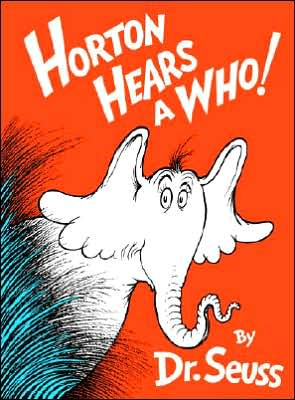
Horton Hears a Who by Dr. Seuss
E SEU
Surely among the most lovable of all Dr. Seuss creations, Horton the Elephant represents kindness, trustworthiness, and perseverance--all wrapped up, thank goodness, in a comical and even absurd package. Horton hears a cry for help from a speck of dust, and spends much of the book trying to protect the infinitesimal creatures who live on it from the derision and trickery of other animals, who think their elephant friend has gone quite nutty. But worse is in store: an eagle carries away the clover in which Horton has placed the life-bearing speck, and "let that small clover drop somewhere inside / of a great patch of clovers a hundred miles wide!" Horton wins in the end, after persuading the "Who's" to make as much noise as possible and prove their existence. This classic is not only fun, but a great way to introduce thoughtful children to essentially philosophical questions. How, after all, are we so sure there aren't invisible civilizations floating by on every mote? (Amazon.com)

February 9, 2011

Thursday Thirteen

Did you know that there is a big difference between "middle grade" fiction and "young adult" fiction? I have noticed these days that my middle grade readers (ages 8-12) are quick to jump in to books that are intended for young adults!  (They ask me for Hunger Games and Twilight!) Young adult fiction is geared towards kids ages 14 to 21.
Middle Grade readers are ages 8-12.   These kids are trying to figure out what  think, and where they fit in. They like books that they can relate to.  Because of this, most themes deal with issues that these kids deal with: school, friendships, relationships with peers and siblings, and daily difficulties that may seem ordinary to to you and me. This age group  is easily distracted,  so the books have a faster pace, lower word count and less chapters.  This week I give you my favorite middle grade books!  

Frindle by Andrew Clements
F CLE
When he decides to turn his fifth-grade teacher's love of the dictionary around on her, clever Nick Allen invents a new word and begins a chain of events that quickly moves beyond his control.

The Lemonade War by Jaqualine Davies
F DAV
Evan and his younger sister, Jesse, react very differently to the news that they will be in the same class for fourth grade and as the end of summer approaches, they battle it out through lemonade stands, each trying to be the first to earn 100 dollars. Includes mathematical calculations and tips for running a successful lemonade stand.

Because of Winn Dixie by Kate DiCamillo
F DIC
Ten-year-old India Opal Buloni describes her first summer in the town of Naomi, Florida, and all the good things that happen to her because of her big ugly dog Winn-Dixie.

The Broken Bike Boy and the Queen of 33rd Street by Sharon Flake
F FLA
Ten-year-old Queen learns valuable life lessons about being a good friend when Leroy, a new kid in the neighborhood, comes to Queen's school.

Million Dollar Shot by Dan Gutman
F GUT
Eleven-year-old Eddie gets a chance to win a million dollars by sinking a foul shot at the National Basketball Association finals.

Among the Hidden by Margaret Peterson Haddix
F HAD
In a future where the Population Police enforce the law limiting a family to only two children, Luke has lived all his twelve years in isolation and fear on his family's farm, until another "third" convinces him that the government is wrong.
The Secret of Zoom by Lynne Jonell
F JON
Ten-year-old Christina lives a sheltered life until she discovers a secret tunnel, an evil plot to enslave orphans, and a mysterious source of energy known as zoom.

Jeremy Fink and the Meaning of Life by Wendy Mass
F MAS
Just before his thirteenth birthday, Jeremy Fink receives a keyless locked box--set aside by his father before his death five years earlier--that purportedly contains the meaning of life. 

One Beastly Beast by Garth Nix
F NIX
A collection of four fantasy tales in which a boy joins a strange navy in pursuit of video pirates, a neglected princess seeks adventure, an orphaned inventor seeks the perfect parents, and a genius girl faces a sea serpent

Lawn Boy by Gary Paulsen
F PAU
Things get out of hand for a twelve-year-old boy when a neighbor convinces him to expand his summer lawn mowing business. 

Beryl: A Pig's Tale by Jane Simmons
F SIM
Tired of being mistreated and cooped up, Beryl the piglet escapes her farm and meets a group of wild pigs, whose settlement splits up over the decision of whether to let her stay, and with her new "family" she sets out to find a new home.

When You Reach Me by Rebecca Stead
F STE
As her mother prepares to be a contestant on the 1980s television game show, "The $20,000 Pyramid," a twelve-year-old New York City girl tries to make sense of a series of mysterious notes received from an anonymous source that seems to defy the laws of time and space.

Charlotte's Web by EB Lewis
F LEW
Wilbur, the pig, is desolate when he discovers that he is destined to be the farmer's Christmas dinner until his spider friend, Charlotte, decides to help him.